
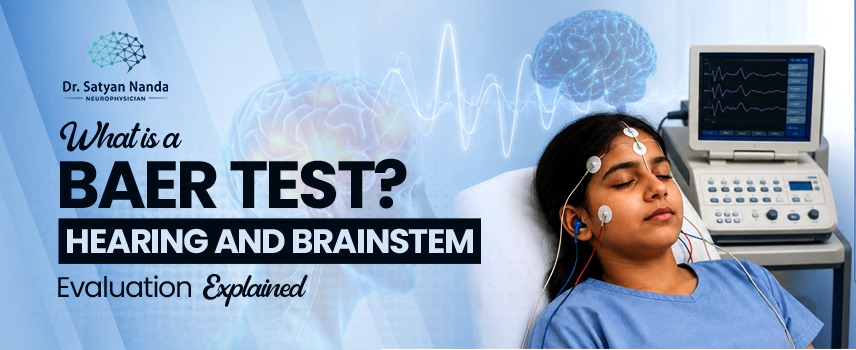
Hearing is one of our most vital senses, but problems affecting the auditory pathway often go unnoticed until symptoms become significant. A neurologist may recommend a Brainstem Auditory Evoked Response (BAER) test if you experience unexplained hearing loss, balance disturbances, tinnitus, or neurological symptoms affecting hearing.
The BAER test is one of the most accurate diagnostic tools available for evaluating the function of the hearing nerve and brainstem. In this guide, we'll explain what the BAER test is, why it's performed, how it works, and what the results mean.
What is a BAER Test?
BAER stands for Brainstem Auditory Evoked Response. It is also commonly known as the Auditory Brainstem Response (ABR) test.
The test measures how the brainstem responds to sound by recording electrical signals generated as sound travels from the ear through the auditory nerve to the brainstem.
Unlike routine hearing tests that measure your ability to hear sounds, the BAER test evaluates whether sound signals are being transmitted normally through the hearing nerve and brainstem.
How Does the BAER Test Work?
When sound enters the ear, it is converted into electrical signals that travel along the auditory nerve toward the brainstem and ultimately the auditory cortex.
During the BAER test:
- Small electrodes are placed on the scalp and near the ears.
- Clicking sounds are played through headphones.
- The electrodes record the brain's electrical responses to these sounds.
- A computer analyzes these responses and produces waveforms.
- Neurologists evaluate the timing and pattern of these waveforms to determine whether the auditory pathway is functioning normally.
Non-Invasive and Safe Procedure
The BAER test is completely non-invasive.
- No needles
- No injections
- No radiation
- No electrical current enters the body
The electrodes simply record the body's natural electrical activity, making the test safe for:
- Adults
- Children
- Newborn babies
- Patients with pacemakers and other implants
Why is a BAER Test Done?
1. Diagnosing Hearing Problems
The BAER test is particularly useful when the cause of hearing loss cannot be identified through routine hearing tests.
It helps diagnose:
- Auditory nerve disorders
- Sensorineural hearing loss
- Auditory neuropathy
- Acoustic neuroma (vestibular schwannoma)
2. Evaluating Brainstem Function
The BAER test also provides valuable information about the health of the brainstem.
Abnormal signal transmission may indicate conditions such as:
- Multiple sclerosis
- Brainstem tumors
- Stroke
- Other neurological disorders affecting the auditory pathways
3. Assessing Hearing in Newborns and Children
Since the test does not require active participation, it is widely used for newborn hearing screening and evaluating hearing in infants and young children.
Even sleeping babies can undergo the test successfully.
4. Investigating Neurological Symptoms
Your neurologist may recommend a BAER test if you experience:
- Persistent dizziness
- Vertigo
- Unexplained balance problems
- Sudden hearing changes
- Tinnitus associated with neurological symptoms
Symptoms That May Require a BAER Test
You may be referred for a BAER test if you experience:
- Hearing loss in one or both ears
- Persistent tinnitus (ringing or buzzing in the ears)
- Dizziness or vertigo
- Balance problems
- Sudden unexplained deafness
- Delayed speech or language development in children
- Poor response to sounds in infants
Although these symptoms do not always indicate a brainstem disorder, the BAER test helps detect hidden problems affecting the auditory nerve and central auditory pathways.
How is a BAER Test Performed?
Before the Test
Patients are usually advised to:
- Wash their hair before the appointment.
- Avoid oils, conditioners, sprays, or gels.
- Remove hearing aids, earrings, and hair accessories.
- Stay relaxed during the procedure.
For infants or young children, natural sleep or mild sedation may be recommended to ensure accurate recordings.
During the Test
During the procedure:
- The patient lies comfortably in a reclined position.
- Small electrodes are attached to the scalp and near both ears.
- Headphones deliver clicking sounds to one ear at a time.
- The electrodes record electrical responses generated by the brainstem.
- A computer averages hundreds of responses to create accurate waveforms.
No active participation is required. Patients simply need to remain still and relaxed.
Duration of the Test
A BAER test generally takes:
- Adults: 45–60 minutes
- Infants and young children: Slightly longer if natural sleep is required
How to Prepare for a BAER Test
Proper preparation helps obtain accurate results.
- Wash your hair thoroughly.
- Avoid hair oils, gels, creams, or conditioners.
- Wear comfortable clothing.
- Continue regular medications unless instructed otherwise.
- Children may be advised to stay awake longer before the appointment so they sleep naturally during the test.
Is the BAER Test Painful?
No. The BAER test is completely painless.
Patients usually feel only:
- The adhesive used to attach electrodes
- Soft clicking sounds through headphones
No electrical current is passed into the body, making the procedure extremely safe.
Understanding BAER Test Results
The recorded responses appear as waveforms labeled using Roman numerals (I–VII), each representing a specific location within the auditory pathway.
Neurologists evaluate:
Presence or Absence of Waves
Missing waves may indicate interruption of signal transmission.
Latency
Delayed wave peaks suggest slower nerve conduction, which may occur in demyelinating disorders such as multiple sclerosis.
Inter-Peak Intervals
Abnormal timing between waves helps identify where along the auditory pathway the problem exists.
Abnormal BAER findings may indicate:
- Sensorineural hearing loss
- Acoustic neuroma
- Auditory neuropathy
- Brainstem lesions
- Multiple sclerosis
- Other neurological disorders
Interpretation should always be performed by an experienced neurologist.
BAER Test vs Standard Hearing Test
Standard Hearing Test (Audiogram)
An audiogram measures:
- How well you hear
- Hearing thresholds
- Different sound frequencies
BAER Test
The BAER test evaluates:
- Auditory nerve function
- Brainstem function
- Neural transmission of sound
A person may have a normal audiogram but still have abnormal BAER findings if the auditory nerve or brainstem is affected.
When Should You Consult a Neurologist?
Consult a neurologist if you experience:
- Persistent dizziness
- Sudden or worsening hearing loss
- Balance disorders
- Hearing problems accompanied by headaches or facial numbness
- Visual disturbances with hearing symptoms
- Delayed speech development in children
- Children who do not respond appropriately to sounds
Your neurologist may recommend a BAER test along with other neurological investigations such as EEG or VEP depending on your symptoms.
Conclusion
The Brainstem Auditory Evoked Response (BAER) test is a highly accurate, painless, and safe neurological investigation used to evaluate hearing nerve and brainstem function. It plays a vital role in diagnosing auditory nerve disorders, neurological diseases, balance disorders, and hearing problems in both adults and children.
Early diagnosis can significantly improve treatment outcomes by identifying conditions before permanent damage occurs. If you or a loved one experiences unexplained hearing loss, tinnitus, dizziness, or balance problems, consult a qualified neurologist for a comprehensive evaluation and determine whether a BAER test is appropriate.
Frequently Asked Questions (FAQs)
What is the purpose of a BAER test?
The BAER test evaluates the health of the hearing nerve and brainstem and helps diagnose hearing loss, dizziness, tinnitus, and neurological disorders affecting the auditory pathway.
Does the BAER test hurt?
No. The procedure is completely painless and non-invasive.
How long does the BAER test take?
Most adult tests take approximately 45 to 60 minutes.
Can the BAER test detect hearing loss?
Yes. It can detect hearing loss caused by problems involving the auditory nerve and brainstem that may not appear on routine hearing tests.
Is the BAER test safe for babies?
Yes. It is routinely used for newborn hearing screening and is considered completely safe.
How is the BAER test different from a regular hearing test?
A standard hearing test measures how well you hear sounds, whereas the BAER test evaluates how effectively sound signals travel through the hearing nerve and brainstem.