
You get your EEG report and read the first few lines. It says “mild diffuse slowing” and “no epileptiform discharges.” You have no idea what that means. Is it good news or bad news?
Don’t worry. Almost everyone feels this way. Doctors write EEG reports for other doctors, so the words sound strange to everyone else. This blog explains your report in simple terms, so you know what it says and what to ask your doctor next.
What is an EEG test?
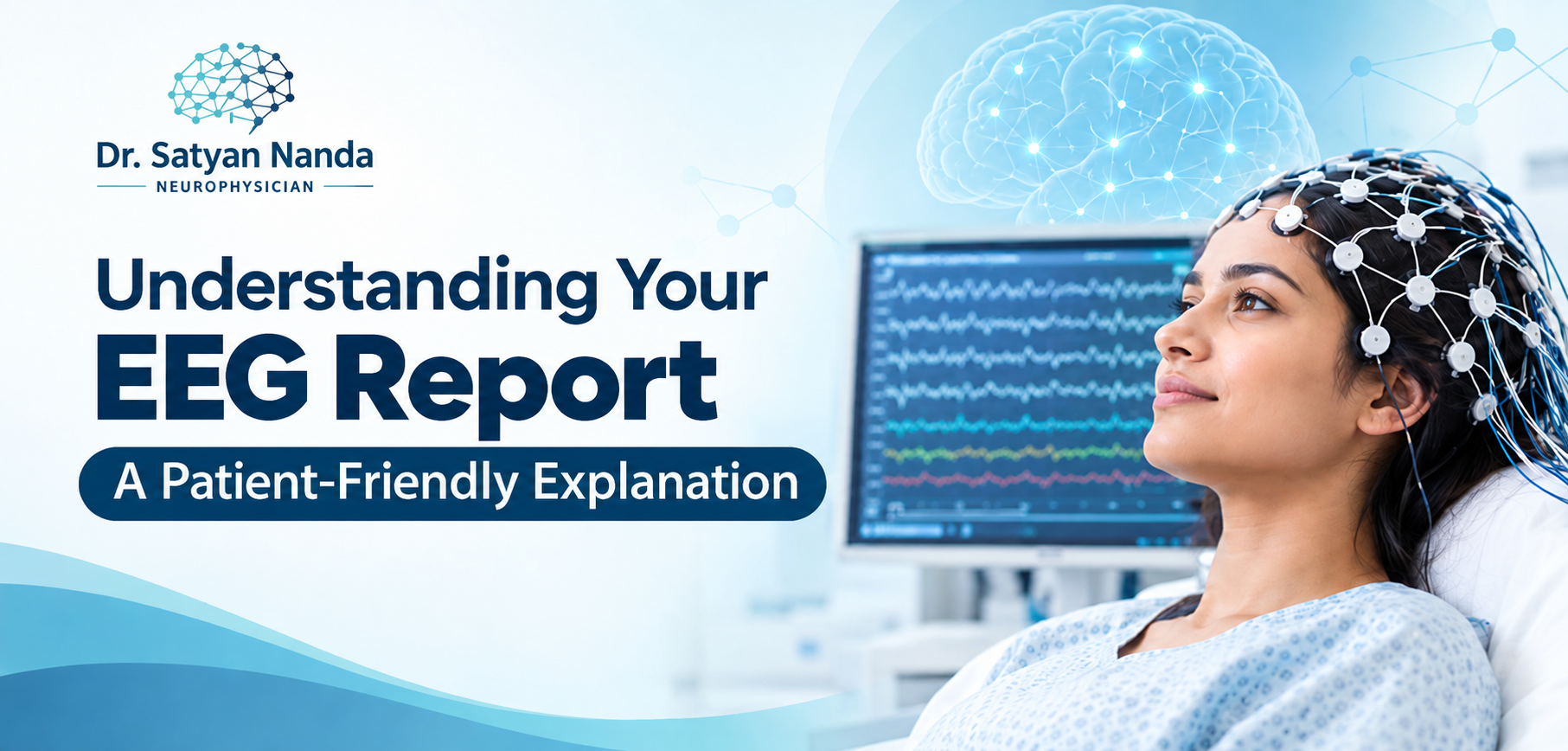
An EEG test checks the electrical activity of your brain. EEG stands for electroencephalogram. Your brain cells talk to each other using tiny electrical signals. During the test, small sensors on your head pick up these signals, and a machine shows them as wavy lines. That is why it is also called a brain wave test.
The test is safe and painless. It only records what your brain is already doing. Nothing is sent into your head.
Doctors suggest an EEG test for seizures, fainting spells, sudden confusion and sleep problems. It is also used after a head injury and when someone has unexplained memory changes.
What happens during an EEG test?
A technician applies small metal disks to your scalp with a gentle paste. Then you sit or lie back and rest. The test typically takes 20 to 40 minutes.
You might be asked to open and shut your eyes, take deep breaths for a few minutes, or look at a flashing light. This shows brain activity that may not show up when you are resting.
Some of the tests include a short sleep. Then the doctor may ask you to get less sleep the night before. Wash your hair the night before; there should not be any oil or gel in your hair.
Take your regular medicines unless your doctor tells you not to.
Different types of EEG
Depending on your symptoms and what your doctor wants to find out, they will recommend a type of EEG (electroencephalogram). The major types are:
Routine EEG: This EEG takes about 20 to 40 minutes and records your brain waves while you are awake.
EEG sleep-deprived: It is performed when you sleep less than usual. Sleep deprivation may improve the detection of particular abnormal brain activity.
Video EEG: This test records your brain activity and video of your movements and behavior simultaneously, often for several hours or days. This test lets doctors link physical symptoms with changes in brain activity.
What is in an EEG report?
Most EEG reports have four sections.
Patient information: Details such as the reason for the test, your name, your age, and why the doctor ordered it.
Technique: How the test was conducted and the state of the person at the time (awake or asleep).
Results: What the doctor saw in your brainwaves.
Impression: A concluding statement at the end stating if the EEG was normal or abnormal.
If you read only one section of your EEG report, start with the impression. It summarises the main findings in a line or two, giving you a quick overview of the results.
Common words in your EEG report
Here are the terms you are most likely to see, in plain language.
Background activity is the usual pattern of your brain waves when you are relaxed. Doctors compare it with what is expected for your age.
Slowing means some brain waves are slower than expected. It can happen with sleepiness, certain medicines, or some brain conditions.
Symmetry means both sides of the brain look alike. If one side looks different, it may point to a problem in that area.
Focal means one specific area of the brain. Generalized or diffuse means the whole brain.
Epileptiform discharges are sudden, sharp spikes in the waves. They are linked to a higher chance of seizures.
Artifact is a signal that did not come from the brain. Blinking, chewing, or moving your head can cause it. Doctors know how to spot and ignore these.
You may also see words like “mild” or “nonspecific.” These are careful descriptions, not warning signs.
What does a normal EEG mean?
A normal EEG means your brain waves look typical for your age. There were no spikes, sharp waves or seizure activity during the recording. The report may say “normal study” or “within normal limits.”
But there is something many people do not know. A normal EEG does not completely rule out epilepsy. Seizures do not happen all the time, and a short recording can miss them. Many people with epilepsy have a normal result on their first test. So a normal EEG is good news, but your doctor will still look at your symptoms and history.
What does an abnormal EEG mean?
The word “abnormal” sounds scary, but it only means the recording showed something different from the usual pattern. It does not tell you how serious that problem is.
An abnormal EEG may show slow waves, a difference between the two sides of the brain, or sharp spikes. Slow waves can be caused by tiredness, some medicines, an infection, or a head injury. Sharp spikes can suggest a tendency to have seizures. Some people also have harmless patterns that look unusual but never cause any problem.
So an abnormal EEG does not always mean epilepsy. EEG interpretation is a skill, and it needs a trained neurologist who reads the tracing along with your symptoms and medical history.
How an EEG helps in epilepsy diagnosis
An EEG is one of the most useful tests for epilepsy diagnosis, but it is never used alone. Your doctor also listens to how your episodes happen. If someone has seen one, their description helps a lot. The doctor will also check your medical history, do a nerve and brain examination, and often order an MRI.
If the EEG shows epileptiform discharges and your symptoms match, the diagnosis becomes stronger. The pattern can also show which type of epilepsy you may have, and that helps in choosing the right medicine.
If the first test is normal but the doctor still suspects seizures, you may need a repeat EEG, a sleep-deprived EEG, or a video EEG.
Why EEG results can change
Your brain waves are not the same every day. Lack of sleep, too much caffeine, stress, fever and medicines can all affect the recording.
That is why one EEG test is not always the final answer. A repeat test, done under better conditions, can sometimes give a clearer picture.
How to understand your EEG test results
Your EEG test results are one piece of the full picture. Before you meet your doctor, write down your questions. Here are a few good ones.
- Was my EEG normal or abnormal?
- Did it show any slowing or spikes, and in which area?
- Does this match my symptoms?
- Do I need any more tests?
- What is the next step?
Take a family member with you if you can, and ask for a copy of the report. Try not to search every word online. The same phrase can mean different things for different people.
Finding an EEG test near me
Most people begin by searching for “EEG test near me”. Distance is a factor, but not the only factor. Look for EEG technicians who are trained and a neurologist who reads the report. Ask what kind of EEGs they offer, how quickly you can expect results, and if a physician will discuss the results with you.
A report you cannot understand can cause a lot of worry. You do not have to figure it out alone. Dr. Satyan Nanda can explain your EEG test results in simple words and guide you on what to do next.
Book your EEG test today for reliable results and expert guidance.
This blog is for general information only and is not a substitute for medical advice. Please speak to a qualified neurologist about your own symptoms and test results.
Frequently Asked Questions
How long does it take to get EEG test results?
EEG results are often available within a few days, depending on the type of test and how long the recording takes to review.
Is an EEG test painful or uncomfortable?
No, an EEG is painless. You may feel slight discomfort when the electrodes are attached or removed, but the test does not involve electric shocks.
Can an EEG detect epilepsy if the results are normal?
A normal EEG does not rule out epilepsy. Abnormal brain activity may not occur during the recording, so your doctor will also consider your symptoms and medical history.
Should I stop taking medication before an EEG test?
Do not stop or change any medication unless your doctor advises you to. Inform the technician about all medicines you take before the test.
Who can explain my EEG report?
A neurologist can explain your EEG findings in the context of your symptoms, medical history, and other test results, helping you understand what the report means for you.