
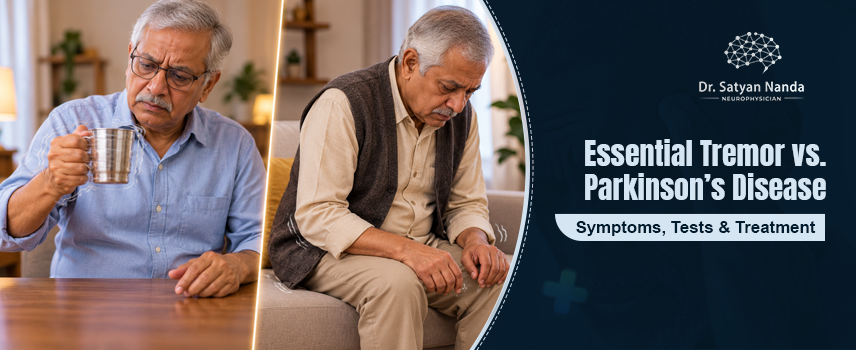
You are holding a cup of chai and your hand begins to tremble. Not much. But enough to make you notice and ask yourself questions such as: Is it my age? Stress? Too much coffee? Or something the neurologist should know?
If this sounds familiar, you are not alone. Tremor is one of the most frequent reasons people visit a neurology clinic, and the two names that come up most often are essential tremor and Parkinson’s disease. They look the same from a distance. Up close, they are very different diseases.
However, understanding essential tremor vs Parkinson’s disease can save you weeks of worry and bring you toward the right diagnosis sooner.
What Is a Tremor, Really?
A tremor is an involuntary, rhythmic shaking of a body part. The primary suspects are the hands, but tremors can show up in the head, voice, legs, or trunk too.
Tremors are not a disease on their own. They’re a sign of some conditions. Behind that sign could be a nervous system condition, a medication side effect, a thyroid problem, or simply a very tired body. That’s why getting the right diagnosis matters so much.
What Is Essential Tremor?
Essential tremor is the most common movement disorder in adults, and it’s far more common than Parkinson’s disease. It usually affects both hands, though one side can shake a little more than the other.
The shaking tends to appear when you’re using your hands while writing, pouring tea, buttoning a shirt, or holding a phone steady. However, at rest, the hands are often calm.
Many people also notice a head nod, a shaky voice, or both. Symptoms often get worse with stress, tiredness, caffeine, or strong emotion.
Essential tremor often runs in families. If a parent or grandparent had “shaky hands,” there’s a high chance that you would also suffer from the same condition.
What Is Parkinson’s Disease?
Parkinson’s disease is a progressive condition that affects the brain cells responsible for producing dopamine. Dopamine is a chemical that helps control smooth, coordinated movement. As a result, in this condition, movement becomes slower and stiffer.
Tremor is only one piece of the picture. Doctors look for a combination of signs:
- Slowness of movement (bradykinesia)
- Muscle stiffness or rigidity
- A tremor that begins on one side
- Balance and posture changes as the condition advances
Many people with Parkinson’s also notice smaller handwriting, a softer voice, a reduced arm swing while walking, and less facial expression. Some experience constipation, loss of smell, or disturbed sleep years before any tremor appears.
Resting Tremor vs Action Tremor: The Clearest Clue
| Particulars | Resting Tremor | Action Tremor |
|---|---|---|
| When it happens | When the muscle is relaxed and supported, like your hand lying in your lap. | When you move or hold a position, like reaching for a glass or holding your arms out. |
| What it feels like | Shaking that settles the moment you reach for something. | Shaking that shows up or gets worse as you start a task. |
| Everyday example | Your hand trembles while you watch TV, then calms when you pick up the remote. | Your hand shakes while you pour tea or sign your name. |
| What it looks like | Often a slow “pill-rolling” motion between thumb and forefinger. | Fine, steady shaking in both hands, sometimes with the head or voice. |
| Subtypes | None. | Postural (arms held out) and kinetic (reaching, writing). |
| Classic link | Parkinson’s disease. | Essential tremor. |
Hand Tremor Causes: It’s Not Always What You Think
Before landing on essential tremor or Parkinson’s, it helps to know that hand tremor causes are wide-ranging. Many of them have nothing to do with either condition.
Common triggers and causes include:
- Caffeine and stimulants, which can make healthy hands shake.
- Anxiety and stress, where adrenaline sets the body trembling.
- An overactive thyroid, which speeds up the whole system.
- Low blood sugar, especially if meals are skipped.
- Medications, including some asthma, antidepressant, and anti-seizure drugs.
- Alcohol withdrawal or heavy alcohol use.
- Lack of sleep and exhaustion.
- Neurological conditions, including essential tremor, Parkinson’s disease, and dystonic tremor.
The takeaway is that, if you are also observing symptoms of trembling in yourself, then you deserve a proper look. Blood tests, a medication review, and a neurological examination can help identify or rule out common, treatable causes first.
Essential Tremor vs Parkinson’s Disease: Key Differences
| Particulars | Essential Tremor | Parkinson’s Disease |
|---|---|---|
| When the tremor shows up | During movement or while holding a posture. | Mostly at rest. |
| Which side is affected | Usually both hands. | Often starts on one side and may stay uneven for years. |
| Other body parts | Head and voice are commonly involved. | Hands, jaw and legs; rarely the head. |
| Other symptoms | Mostly just the shake. | Slowness, stiffness, balance trouble, plus poor sleep or a reduced sense of smell. |
| Handwriting | Shaky or wobbly. | Often very small and cramped. |
| Family history | Strongly linked. | Less commonly inherited, though it can happen. |
| Progression | Usually worsens slowly over many years. | Progressive, with a wider range of symptoms over time. |
What Causes Each Condition?
The honest answer is that the researchers aren’t sure of all the puzzle pieces yet.
Essential tremor seems to be caused by abnormal signaling in the brain circuits that control movement, especially those connected to the cerebellum. Genetics seem to play a large role, as do clustering in families.
Parkinson's disease is the progressive death of dopamine-producing cells in a brain region called the substantia nigra. Factors believed to be involved include genetic susceptibility, age, and environmental factors, but no single cause has been identified.
How Doctors Tell Them Apart
There is no single blood test that differentiates the two. Usually, a neurologist will start with your story: when did the tremor start, what makes it better or worse, and who in the family has had similar symptoms.
Then the physical exam is performed. You could be asked to touch your nose, draw a spiral, walk across the room, or extend your arms. Each task provides you with different information about the tremor.
If the diagnosis remains uncertain, a neurologist may recommend specialised brain imaging tests, such as a Dopamine Transporter (DaT) scan or an 18F-F-DOPA PET scan, to assess the brain's dopaminergic system. These scans can help identify changes in dopamine-related activity associated with Parkinson's disease. Thyroid or metabolic problems can also be ruled out with blood tests.
Treatment: Different Conditions, Different Paths
Because the two conditions behave differently, treatment differs too.
Essential Tremor Treatment
For essential tremor, doctors may recommend medications such as propranolol or primidone. Lifestyle steps like cutting back on caffeine, managing stress, and using weighted utensils can help. For tremors that disrupt daily life, options like focused ultrasound or deep brain stimulation may be considered.
Parkinson’s Disease Treatment
For Parkinson’s disease, treatment often centres on medications that restore or mimic dopamine, such as levodopa. Physiotherapy, regular exercise, speech therapy, and occupational therapy play a big supporting role. Advanced cases may also benefit from deep brain stimulation.
Neither path is one-size-fits-all. Your neurologist will tailor the plan to your symptoms, age, and daily needs.
When to See a Neurologist
Don’t wait it out if you notice any of these:
- A tremor that’s getting steadily worse.
- Shaking that interferes with eating, writing, or dressing.
- Tremor on one side only, especially at rest.
- Stiffness, slowness, or shuffling steps.
- A sudden change in your tremor pattern.
Early assessment brings clarity, and clarity brings calm. Even if the answer turns out to be something simple, you’ll know.
Shaky Hands? Get Clear Answers.
You don’t have to guess whether your tremor is essential tremor, Parkinson’s, or something else entirely. Dr. Satyan Nanda can assess your symptoms, recommend appropriate tests, and build a care plan that fits your life. Book a consultation with Dr. Satyan Nanda today and take the first steady step.
Disclaimer: This article is for general information only and is not a substitute for professional medical advice, diagnosis, or treatment. Please consult a qualified neurologist about your symptoms.
Frequently Asked Questions
Can essential tremor turn into Parkinson’s disease?
No. They are separate conditions. Some people can have both, but one does not become the other.
Is a resting tremor always Parkinson’s?
Not always, but resting tremor is the classic sign of Parkinson's disease. However, a neurologist should confirm the cause.
Is essential tremor dangerous?
It isn’t life-threatening and doesn’t damage the brain. It can still interfere with daily tasks and affect the person's confidence.
Does caffeine make hand tremors worse?
Yes, caffeine can worsen hand tremors, especially in sensitive individuals. Reducing your caffeine intake may help, but persistent tremors should be evaluated by a healthcare professional.
Can stress cause hand tremors?
Yes. Stress and anxiety can trigger or worsen shaking, even in people with no neurological condition.